Showing posts with label Battlegroup. Show all posts

Thursday, 24 November 2022

Battlegroup Westwall


I thought I'd share a few pictures and initial feelings about the new softback Battlegroup supplement covering the battles at Germany's border in Autumn 1944: Battlegroup Westwall.

Now Westwall is a softback supplement so is designed to be used with a couple of other Battlegroup products, these being the rulebook and the Axis and Allies lists from Overlord (or the later reprint Beyond the Beaches) so you'll need those to get the most out of it - although like all Battlegroup products the history and scenarios included can be worth the cost and this also has a mini campaign included!


So, presuming you're not like me and just slowly collecting all of WW2 (I jest but it's getting closer) is this book for you? As previously stated it covers the period after Normandy but before Wacht Am Rhein (Bulge) and Into the Reich - so September to November. Although the British were also fighting fiercely at this point their main focus was Holland (and any suitable rules found here can be used for Holland - Battlegroup is a tool kit) and this book focusses primarily on the American forces slogging their way through the dilapidated re-re-done fortifications of the Westwall: the last line protecting the Fatherland, as the remnants of the once mighty German army desperately re-arm and reform behind it. It also covers the particular misery of the fighting in "the Big Hurt" or Huertgen forest with special rules for thematic occurrences like airburst in canopy and forest floor. 


Like all Battlegroup books there is a comprehensive history overview section that covers the background events leading up to and action from Aachen to Huertgen Forest, the events around Lorraine and the fortress city of Metz. As ever its well written, has a great selection of real pictures and miniature shots and lots of interesting informational inserts with details about key events. Now you may ask why you need 26 pages of History information you could get anywhere else, but I would argue the history is so well written and focused, including giving a breakdown of the units involved and the action you're trying to portray that it is necessary and really beneficial for beginners and old hands alike (I think I have definitely forgotten more about WW2 than I'll ever know). People would definitely complain if it wasn't there (they’ll complain no matter what) and for the newcomer to WW2 gaming it is a real boon - it may even spark your interest in the historical side.


 Whilst it uses the lists from Overlord (only one full list in this book - the German Panzer Brigade Battlegroup) there are the usual additions and subtractions listed for all the necessary forces so you can tailor the Volksgrenadier Division list (Wacht Am Rhein), Germany Infantry Division 1944 (Overlord) and Armoured and Infantry Combat Engineers for the US lists (Overlord). 


The key addition present here is for the german lists in the form of the new Defense section with more detailed Westwall specific defenses including sparse minefields, flak bunkers and a comprehensive list of bunker types with new options such as defensive machineguns and flamethrower shelters. This is a really interesting section and breathes new life into any bunkers you have for already bought for those rarely played and often harrowing Normandy landing games. 


Alongside the lists and amendments is the scenario section. Battlegroup is well known for its generosity and proliferation of scenarios in its books and this one delivers with .....one. Yep just the one but it's important and not unexpected. It's an attack/defense scenario with the Axis player holding a fortified defensive line, nothing too shocking there. This isn't bad news however as many there are another 6 scenarios hidden away in the section after the army lists; the mini campaign. 


The Clipper Campaign is a 6 battle mini campaign covering Operation Clipper in late November 1944 and can be played as Americans or British (if you don’t have US) against the Germans (in reality it was the US vs Germans). There are six scenarios to be played that are squad to platoon in size (1 squad and 5 platoon sized games) with the historical forces listed or the ability to select replacement forces from your available miniatures (as usual). It's not as complicated as the Torch/Kasserine one but a nice addition that should be doable in a good, long weekend or over a few weeks at club.


As stated the full list presented here is the German Panzer Brigade Battlegroup which replaces the standard panzer Brigade from Overlord. This is a very thematic list which may admittedly seem bland to those not interested in or aware of the historical significance of the options: as it appears to simply have very few options. This list represents the armoured counter attacks (mostly the southern Lorraine front) by the new, very cut down Panzer divisions and is a welcome addition to the available stable of late war formations. The Author goes as far to state that the traditional panzers divisions of Normandy and Into the Reich aren't suitable for this period of conflict and you should look to Wacht Am Rhein if they are more your taste.

This new supplement arrived this morning (I paid for it myself and everything) and I'm really pleased to add it to my existing precious pile of Battlegroup books - I may not play much Westwall but Huertgen is on my list (when I finish my trees) and I intend to keep picking up any books The Plastic Soldier Company puts out in the Battlegroup series. 

Battlegroup:Westwall can be bought direct from The Plastic Soldier Company here.


Stay safe,

BeneathALeadMountain

Wednesday, 11 November 2020

A little progress.......

 Greetings all. I hope 2020 is treating you well...... OK maybe not ‘well’ but you’re hanging in there, it won’t be forever, soon it will be a weird memory that those that didn’t experience it won’t really understand (and hopefully will never have to).

 Talking of things that are hard to understand without being there I just watched a new mini series on Netflix about WW2. The Liberator is about Felix Sparks and his role in the 45th Infantry division (nicknamed the Thunderbirds) and their path through the later period of WW2. It follows the characters through Italy via Anzio and then during Operation Dragoon (landings in the south of France) and into Germany including their discovery of concentration camps and the horrific practices undertaken there. The interesting thing about this particular American unit was that it was made up of Native Americans, Mexicans and Americans, people who at that time in their home country wouldn’t have been able to drink together in the same bar. It was a highly decorated unit, that fought hard throughout these campaigns but also has a number of accounts of war crimes attached to them. I can’t comment on these as I can’t even imagine what the war was really like but they are covered in the series and more information about the unit can be found here (it’s Wikipedia so I presume it’s accurate but better sources are probably available). One of the most stunning things about this series is the way it was shot using something called Trioscope. This leads to an almost animated, cel shaded look that adds a beauty to what are horrific and frightening events. I really enjoyed it and think it was well worth watching if you have Netflix.


Apart from that I’ve achieved a few things but nothing of any great measures. Whilst I’ve been interested in WW2 gaming for a while I’ve never had much interest in the Naval actions. When I bought the excellent Post Captain from ODGW games I noticed that they also had a WW2 Naval set called General Quarters 3, luckily I managed to have a flick through a friends copy and was intrigued by how they seemed to work. I started reading various Osprey books and was soon swamped by how complicated and vast the subject was so I asked for some help on a starting point from the publishers forum and ordered a copy from the only people in the U.K. that stocked them. The forum response was excellent and very helpful but the company selling the rules were not. When I used their website I noticed a couple of odd things like the fact that they charge a surcharge for using PayPal (not allowed by PayPal and also by U.K. legislation), when I asked them about it they were flippant and claimed PayPal was expensive (they’ve obviously never had a business bank account) and that they were well within their rights. Shockingly after I politely pointed out that they couldn’t do what they were doing, they said my card wasn’t working and then cancelled my order without contacting me (I’d joked with my wife that I’d never get what I ordered but was still slightly shocked). Annoyed and slightly flummoxed I gave up on ever obtaining the rules, but a few days later I had a better idea.

 I contacted the creators, ODGW, and after a couple of explanatory emails managed to set my wife up as a seller of their rules. I’m still waiting for our first shipment to arrive (due on Friday) and will post about them excitedly as soon as they arrive. I haven’t mentioned the original U.K. company but they are well known and if you go onto many of the gaming forums there are lists of people having problems with their non-existent customer service and refusing to buy anything from them. ODGW make excellent rules (and are lovely people) and I don’t think that the behaviour of an unconnected rubbish company should have an effect on whether people in the U.K. get to play their games so hopefully soon I can change that.

 When I found GQ3 I also found a game called Action Stations by David Manley which focuses on the coastal actions that were prevalent throughout the war and this also piqued my interest. To work out what scale I would play GQ3 in I decided to order some Figurehead 1:6000 destroyers from Magister Millitum and whilst doing so I noticed that they also sold 1:1250 coastal ships and bought a pack of these to see what I thought.

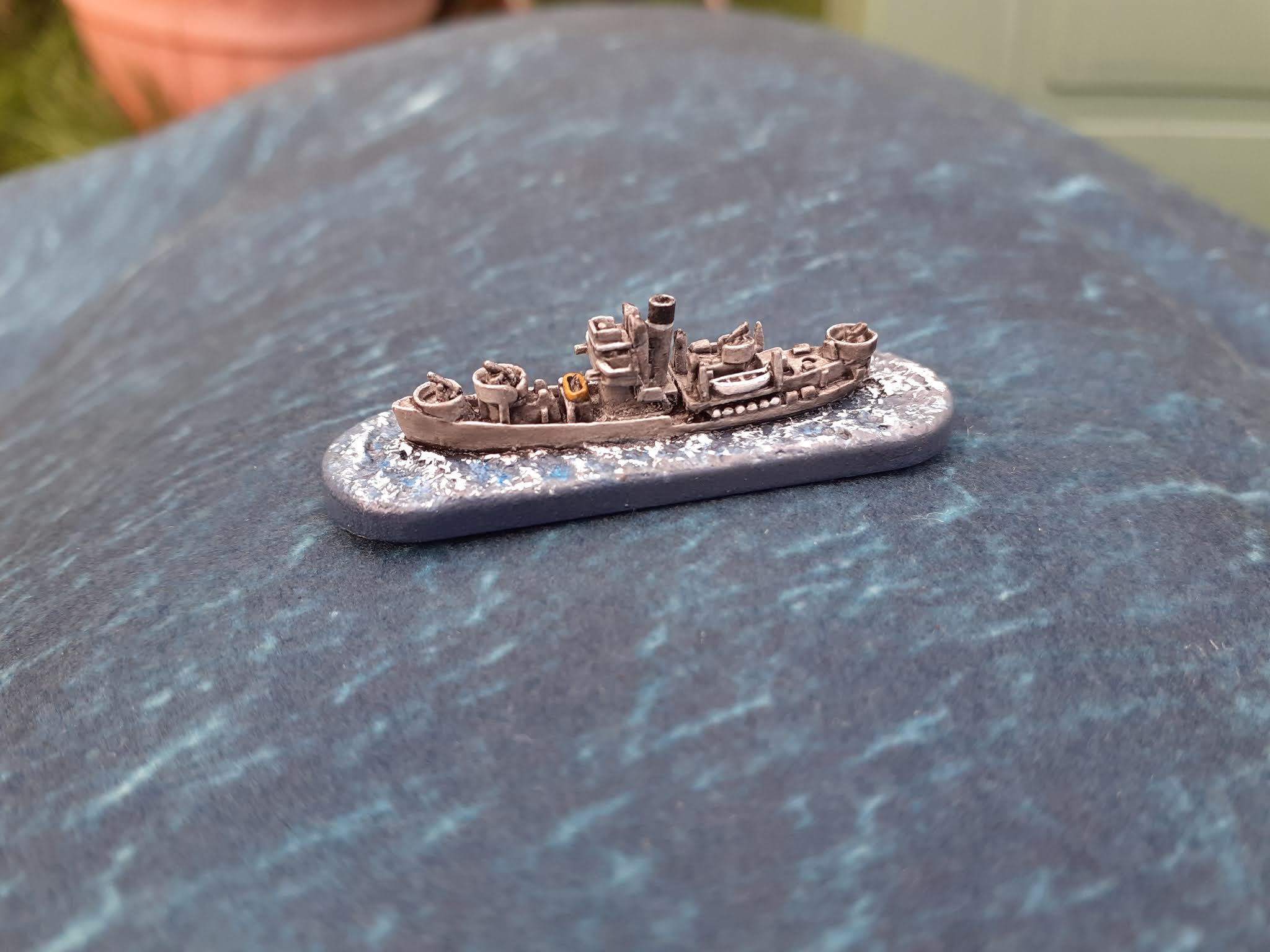
Well the two packs I ordered arrived promptly and with mixed results. Not surprisingly the 1:6000 destroyers were tiny but my key issue was that they are fixed to their bases (and yes I do want to put them on bases, but my bases not pre-cast metal ones. I know - picky) and whilst I managed to remove some of them I’m not sure they are worth the effort. The 1:1250 coastal ships were a different matter though. I bought a pack of Vorposternboot (converted German trawlers) and they are brilliant. Cleanly cast and frankly charming I quickly based up one of the ships and got it painted.


They are based on pill bases from Fluid 3D workshop and then I used Vallejo plastic putty to sculpt the water effects, which for a first go I’m quite happy with. Painting was very easy and I just needed to pick out a few details like depth charges  and lifeboats and the little ship came to life. I may have painted the water too brightly as I used a tiny bit of GW Talassar Blue contrast paint as a wash but when I placed them onto my sea gaming mat they worked quite well.

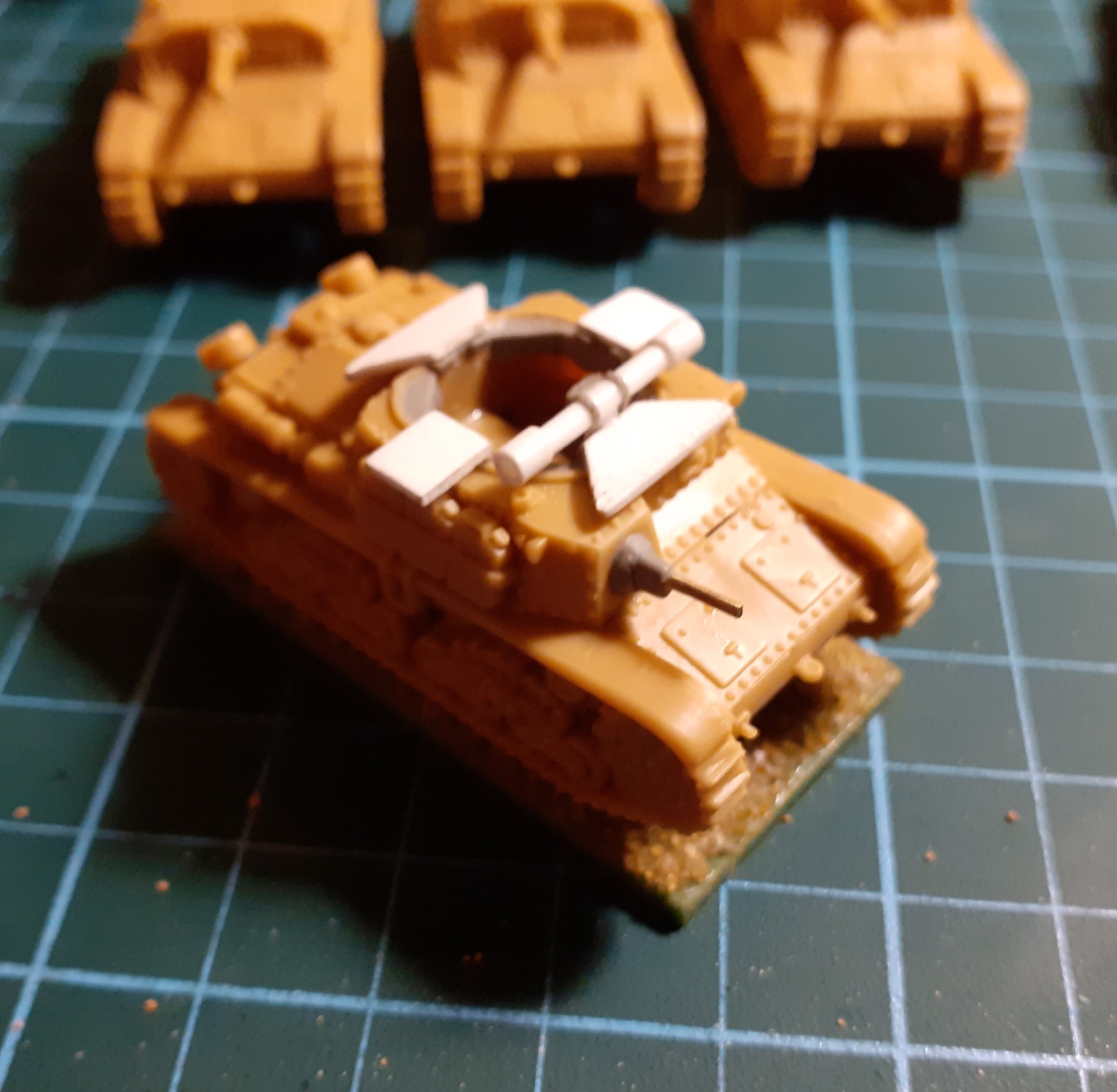
Apart from that I’ve put together a pair of Hornisse or Nashorns (large German self propelled guns) and Ferdinands (like a stug on steroids) which can be used on the Eastern front or in Italy and being relatively  few in number, in reality and in Battlegroup (I believe they are both restricted choices), I may do one of each for each theatre. Below is the first of my Hornisse (Hornet) which were also called Nashorn (Rhino) very much a sit and wait ambush vehicle.


That’s about it, I’ve dabbled in a few other things and regularly stare at my lead mountain trying to work out what I can do about it. As the Welsh fire break action has ended I should be able to get my wife to go to the post office for me and will start chipping at the surplus of my hoard later this week.

 I mentioned briefly before that I’d had a bit of a slip in the garden and damaged my hand. I was very lucky and did no serious permanent damage to myself. This has healed but has left a meaty scar and I’ve been slow getting back into doing hobby stuff but hopefully I’ll pick up speed now. 


Thank you for taking the time to read through this, I hope you’re being more productive than I am currently, stay safe.

BALM


Monday, 28 September 2020

My forces for Operation Torch - or what have I been doing during COVID?

 Greetings all, I hope you are still coping with the unusual times we’re currently experiencing. Previously I’ve mentioned that my actual progress in my hobby is not very well represented by my blog posts - a mixture of frustration at computers (blogger is very hard to use on iPad recently - as I type this I cannot actually see what I’m writing and when I try and put pictures in a minute there will be swearing) and a feeling that it just isn’t that interesting. Well recently I’ve decided to give in and bore any poor reader who found their way here because if nothing else it’s a small distraction from the real world. 

Since just before Christmas I’ve been taking random boxes of 15mm tanks and vehicles I have stockpiled and trying to at least move them forward by sticking them together and basing them. I haven’t progressed to painting partly as I’ve lost my painting mojo and I was also stuck trying to match my basing colours with my chosen gaming mat (Cigar Box battle mats Arid region - it has a ground colour of a beige and pink flesh tone in it and sparse foliage scattered across it) but I think I’ve solved that problem.


For Operation Torch I wanted to collect Italians and Germans with British and Americans opposing them. My American platoon is already based along with a few vehicles like an M8 Scott, M1 Scout car as they were originally for Normandy but I decided to repurpose them and build a new platoon for Overlord at some point in the future. Not everything is finished and in some cases there a few more waiting to be built but this gives a good example of what I’m intending to have as a final force. So we have M3 Lees, early M4 Shermans, halftracks (only 1 but more to come), trucks, T30 halftracks (75mm howitzer), M1 scout car, various jeeps (spotters and a radio version) and Beeps, Portee’d anti tank guns and M3 Stuart’s. So still a number of vehicles to finish or tart up with sculpted details and crew but definite progress.


The British are the least completed (maybe started is a better term) force but if you look carefully at the pictures of the drawers I keep my WIP models in you can see 6 pounders and a couple of scout cars (you can also see some of my limited armour for VBCW including a T1 cavalry tank and some Konflikt ‘47 walkers in their original, and honestly much better, scale). I will get back to the Brits but as I had my American infantry re-headed and based it seemed sensible to focus on them to get a working allied force done.

For the Axis I have Germans and Italians. The Italians are represented by a Bersaglieri platoon (half done and charming in their pith style sun helmets and ostrich feathers) and a range of vehicles from M41 tanks and semoventes, dovunque 35 lorries and Lancia 3RO 6-ton trucks including two (one pictured) with 90mm guns mounted on them, TL-37 artillery tractors and a section of motor cycle based rifleman for a bit of mobile reserve. I could still do with some Sahariana vehicles to act as a mobile elite force but there’s easily enough for Chain of command, Bolt Action or small games of Battlegroup (the Germans will bolster their forces in bigger games). I also made a Carro commando M41 command vehicle out of one of the FoW plastic M41s. Ive also got a number of infantry guns and support weapons to base up to help give the troops a bit more punch.


For the Germans I have a good range of vehicles to support my intended two platoons of infantry. I’ve based and re-headed one platoon in trench coats (Tunisia was cold at night and very different to the sweltering deserts of ‘41)  and they will have a kradschutzen platoon added to them soon (I have the bikes but not the chaps yet) as I felt they would be very different to the other forces and give a highly mobile but fragile fighting force. The vehicles for the Germans range from Panzer III (mainly J’s) and Panzer IV’s (newly arrived in the desert and a dangerous foe), a Bison (daft and pretty unique but cheap from eBay), sdkfz 6 Diana SPG, various artillery tows (sdkfz 7 and 10’s) and scout cars and the utterly weird SdKfz 254 (minus its aerial frame at the moment as it’s thick and clunky and I think I can do better). There is also  some captured and converted Lorraine schleppers and a Tiger. For command vehicles or particular individuals I’ve sculpted crew members using Peter Pig heads to make them a little bit more ‘mine’ (the panzer commander has a cigarette if you squint at my awful photos). Where turrets aren’t attached that is because on taking them out of storage one of the magnets has become detached and they’re waiting for the glue to dry.


So that’s a pretty good overview of some of what I’ve actually done recently. There are quite a few more vehicles to build, base and in a lot of cases add some sculpted details to in order to make them a bit different. I’ve also got to finish the infantry (and buy my kradschutzen troops on foot) but I feel like I’m actually making some progress and hopefully by the time the COVID problem has become more manageable and I’m allowed to mingle again I should be able to start playing some Chain of Command, Bolt Action and Battlegroup in Tunisia. Hopefully I can also use some of the scenery and as much of the forces as possible to play the conflict in Italy (with some key scenic additions like olive groves and Italian style houses) in the future. Apologies for the picture quality and the lack of captions on the pictures but writing this up has probably taken longer than it does to build most of the forces and as I may have mentioned blogger is very hard to use at the moment (I know it’s not just me and that many other bloggers are struggling as well).

Thank you for taking the time to read this, please get in touch and ask any questions or tell me about your own forces for this theatre.

Stay safe and well

BALM

Wednesday, 9 September 2020

A quick look through Battlegroup Pacific War


So a new Battlegroup book has arrived and this one is the first step (lets hope there’s more) into the Pacific Theatre, more specifically the Pacific and Far East in 1944-45. This book like the others in the series is by Warwick Kinrade and is a supplement so you do need the separate rule book to play.

Straight away the book is obviously good quality, it’s hard bound and full of background information, period photographs and pictures of miniatures on beautiful tabletops to help inspire you. First up there is a contents page and an introduction by Warwick about what the book is and how he came to make some of the decisions and choices. 


Next up, like all the Battlegroup supplements there is an excellent introduction to the actions and forces in the theatre. It’s well written and engaging with numerous interesting sidebars about specific conflicts, events and participants. It always surprises me when I see people complaining on forums about the fact you have to have a rulebook and a theatre specific supplement, these books are excellent value and the background information allows a complete WW2 novice to get a grip on their chosen theatre and have a good fundamental knowledge of the types of conflict you’re trying to represent. Even a knowledgeable WW2 buff will find information they didn’t know or benefit from the succinct and well written recap on the Pacific.

After the background information there is a section on amphibious assaults (it seems the similar to the original Overlord book) with special rules that will allow you to represent the Amtracs, DUKW’s and landing craft desperately battling to shore in an attempt to secure a foothold on the island of your choice. Next there is a section on the theatre specific rules that give the real flavour of the conflict and how it differs from say Normandy or Tunisia. This covers things like the use of direct lay mortar fire, combat shotguns, lunge mines and Nikaku teams and even a close protection team for an M3 Grant tank (a group of chaps that occupy the back deck of the tank and use their sub-machine guns to keep enemy infantry away from their precious ride). There is the expected Banzai rules which seem very well thought out and this sections hints at the fact that these battles are going to be very different from other games of Battlegroup I’ve played so far.


After the theatre specific rules there’s a description of the new counters (the system that makes Battlegroup such a fun, tense and dare I say realistic game - as realistic as pushing little metal dollies around a table could be) and their effects. Whilst some supplements share counter sets the Pacific one is a new and unique set that instils the flavour of the island hopping or jungle fighting that went on.

Next up the book has 5 force organisation charts. Two for the Imperial Japanese Army in 44-45 (an Infantry division list with adjustments for playing in Burma and an Island garrison force), two for the US (a Marine Corps list and an infantry division list) and a list for the British in Burma (later in the book in a separate section on Burma as it’s quite different to the island hopping campaigns) with adjustments to represent the Australians. It’s very noticeable that these battles will be very infantry-centric and armour is not as prolific as most other theatres. Whilst the American and British have Grants, Sherman, Stuarts and Matildas the Japanese armour is scarce and out dated. If you’re a fan of tanks then this theatre may not be your favourite but it does allow the importance and actions of the poor bloody infantry to shine (also the forces will/should be easier to collect as unlike say, the Germans in 1944 you won’t need umpteen numbers of various armoured vehicles to allow you to field just a few representative forces, a couple of tanks should cover most of your needs).

The army lists are exactly what you’d be used to with this system but the lists have some excellent thematic units like war dogs for the marines (gives you scout2), amphibious landing craft and AFVs or the discussed close protection teams for British Grants. It’s the Japanese lists that are the most interesting. As the period covered is when the Marines are on a roll and the Japanese are effectively retreating or fighting to the last man. There are ways to add BR to your overall rating or diminish the war weary Americans as they lose the will to keep grinding against a force of fanatics that already consider themselves dead. There is the option for a Japanese Last Remnants platoon where the poor chaps have very few if any firearms (and often no ammo) and have to rely on the trusty bit of sharpened bamboo to defend themselves with.


The Japanese defences section is really characterful from spider holes with varying occupants, to numerous booby traps or concealed caves that allow multiple infantry units to appear as if from no where.


After the lists is a section covering specific terrain - jungle and assorted undergrowth. This is very different to the scenery used for the European theatre and really hammers home the problems for vehicles and infantry fighting in such a complex environment. As a table you are going to need a lot of trees and undergrowth to get the feel for what you’re trying to represent (people always seem to ignore terrain but it really is the third army on the tabletop and generally the better the terrain the more fun the game IMHO).

Next up is 5 scenarios ranging from Amphibious assault, to taking/holding a beach stronghold or overlooking fire base and then the fight through dense jungle and the importance of taking and holding key hills. Like all the Battlegroup scenarios they have a map, background information and any specific rules and example forces to fight it out (but you can always adjust these to fit your collection) and whilst these are specifically ‘Pacific’ in flavour many if not most of the scenarios throughout the series of books can be adapted to fit your chosen battlefield.

After this is the section on Burma, with its own background information and the British infantry division list with a helpful addition to allow you to represent the mighty Australians.


Finally you have the standard Appendix covering the weapons and vehicles of both sides, quick reference sheets and the all important BR counters. Also you get to see the first vehicle reference cards for the Japanese.


So that’s about it for this ‘quick’ look at Battlegroup Pacific. I’m really excited for it and whilst I’m still working on Overlord (and into the Reich) and Tunisia I can see how it should complement these other two theatres and provide a third and different experience. If you haven’t tried Battlegroup I can’t recommend it enough, it’s straightforward but feels engaging and has strong flavour. It works on different sizes from small squad games up to platoons and above, with each size giving a fun, playable experience.

I hope this has been of some use and if you want a copy it can be bought from The Plastic Soldier Company’s website here. Apologies for the bad photography as I’m down to one hand (your palm can burst if you hit it hard enough, something I found out this week) which is going to slow down my already ambling hobby speed but at least I’ve got a new book to digest.

Stay safe and well, feel free to comment or ask me any questions about the book,

BALM